Evaluating Watercolor Logo Templates V.2 for Brand Identity Projects
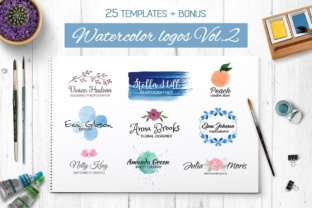
Selecting the right visual identity assets requires balancing aesthetic appeal with technical practicality. For designers, small business owners, and content creators seeking an organic or artistic brand presence, Watercolor Logo Templates V.2 presents a specific solution within the digital asset marketplace. This collection comprises 25 premade logo templates featuring hand-painted floral elements and curated font combinations. Before integrating this resource into a project workflow, it is necessary to understand its composition, utility, and limitations relative to custom design work.
Composition and Technical Specifications
Understanding the deliverables is the first step in determining if this template pack aligns with current technical capabilities. Watercolor Logo Templates V.2 is structured to accommodate users across different skill levels and software access points. The package includes three distinct file formats for each of the 25 designs:
- Layered PSD Files: These are essential for users with Adobe Photoshop or compatible editing software. They allow for granular control over individual watercolor splashes, text placement, and color grading.
- JPG Files: Standard raster images suitable for immediate use in web contexts or documents where transparency is not required.
- PNG Files: Crucially, these files feature transparent backgrounds and exclude text. This specification allows users without specialized design software to import the floral graphics into platforms like Canva, Microsoft Word, or website builders, adding their own typography separately.
Additionally, the collection provides a list of 24 free fonts used in the original logotypes. This inclusion addresses a common friction point in template usage: licensing. By identifying free alternatives, the resource reduces the barrier to entry and ensures legal compliance for commercial projects, provided the user verifies the specific license terms of each linked typeface.
Aesthetic Positioning and Target Applications
The visual language of Watercolor Logo Templates V.2 is distinctly soft, organic, and illustrative. The hand-painted nature of the floral elements distinguishes these assets from vector-based or geometric logo systems. This aesthetic is not universally applicable; it serves specific niches more effectively than others.
This style is typically a strong fit for industries that prioritize warmth, craftsmanship, and personal connection. Common applications include:
- Boutique retail and e-commerce (jewelry, clothing, gifts)
- Wedding and event planning services
- Beauty, skincare, and wellness brands
- Artisanal food and beverage businesses
- Creative portfolios and blogging
The "cute and interesting" descriptor associated with these templates suggests a departure from corporate minimalism. Users evaluating this pack should assess whether this level of informality aligns with their brand voice. If the goal is to convey institutional authority, technological precision, or luxury exclusivity, the inherent playfulness of hand-painted watercolors may create a dissonance between the visual identity and the business value proposition.
Benefits Versus Tradeoffs
When comparing Watercolor Logo Templates V.2 against commissioning a custom designer or generating AI art, several objective tradeoffs emerge. Recognizing these helps manage expectations regarding uniqueness and flexibility.
Efficiency and Cost-Effectiveness
The primary advantage is immediacy. With 25 pre-composed layouts and included typography references, a functional brand mark can be finalized in minutes rather than weeks. For startups testing market viability or seasonal projects requiring rapid deployment, this efficiency often outweighs the need for bespoke exclusivity. The inclusion of transparent PNGs further accelerates workflows for non-designers who need professional-looking assets without learning complex masking techniques.
Customization Limitations
While the PSD files are layered, the underlying artwork remains static. Users cannot alter the brushstroke direction, change the flower species, or modify the lighting of the hand-painted elements without advanced digital painting skills. Unlike vector logos, which scale infinitely and allow for shape manipulation, these raster-based watercolor textures have resolution limits. Enlarging them significantly for large-format print (such as signage or vehicle wraps) may result in pixelation or loss of detail. Users must verify the DPI and pixel dimensions of the source files before committing to them for large-scale physical applications.
Exclusivity Considerations
As a commercially available template pack, these designs are non-exclusive. Multiple entities may utilize the same base floral arrangement. While changing the text and color palette creates differentiation, the core graphic element remains shared. For businesses operating in saturated local markets or highly competitive digital spaces, this lack of uniqueness could be a drawback. Conversely, for hobbyists, side hustles, or internal project branding, the cost savings usually justify this compromise.
Decision-Making Framework for Buyers
To determine if Watercolor Logo Templates V.2 is the appropriate investment, consider the following evaluation criteria:
- Software Compatibility: Do you have access to Photoshop for full editing, or will you rely on the transparent PNGs? If relying on PNGs, does your preferred platform support external image uploads with transparency?
- Brand Alignment: Does a hand-painted, floral aesthetic accurately represent your service or product? Review the 25 variations critically; if fewer than three resonate, the pack may be too narrow in scope.
- Usage Context: Are the primary touchpoints digital (social media, websites) or small-format print (business cards, tags)? If yes, the resolution is likely sufficient. If large-format print is required, request sample dimensions before purchase.
- Licensing Verification: Always review the End User License Agreement (EULA). Confirm whether the templates permit commercial use, modification, and trademark registration. Note that trademarking a template-based logo is often restricted or impossible because the graphic element is not unique to your business.
When to Consider Alternatives
While this template collection offers significant value for specific use cases, alternative approaches may be superior in certain scenarios. If the brand requires a scalable vector format (SVG/EPS) for infinite resizing, a vector-based template pack or custom illustration is necessary. If the business operates in a sector where distinctiveness is a legal or competitive requirement (e.g., trademark-dependent franchises), investing in original custom artwork is the safer long-term strategy.
Furthermore, if the desired aesthetic leans toward modern minimalism or tech-forward geometry, the organic texture of watercolor may feel dated or off-brand. In such cases, exploring line-art botanical templates or typographic-only logo systems might yield better alignment with strategic goals.
Ultimately, Watercolor Logo Templates V.2 serves as a practical tool for achieving a specific artistic look with minimal resource expenditure. Its value lies in its accessibility and the versatility of its file formats, particularly for users bridging the gap between DIY design and professional presentation. By objectively weighing the convenience of premade assets against the requirements for scalability and exclusivity, buyers can make an informed decision that supports both their immediate design needs and long-term brand integrity.